QUOTED FROM THE AKC WEBSITE:
"...there is nothing in AKC rules and in fact nothing in any breed standard that compels an owner to have this procedure performed as a prerequisite to entry at a dog show. Even if it is traditional in a particular breed that the dogs have one of these alterations, it has the same potential to win as any other dog of the breed and will only be judged based on the compliance of that dog to the breed standard."
"...there is nothing in AKC rules and in fact nothing in any breed standard that compels an owner to have this procedure performed as a prerequisite to entry at a dog show. Even if it is traditional in a particular breed that the dogs have one of these alterations, it has the same potential to win as any other dog of the breed and will only be judged based on the compliance of that dog to the breed standard."
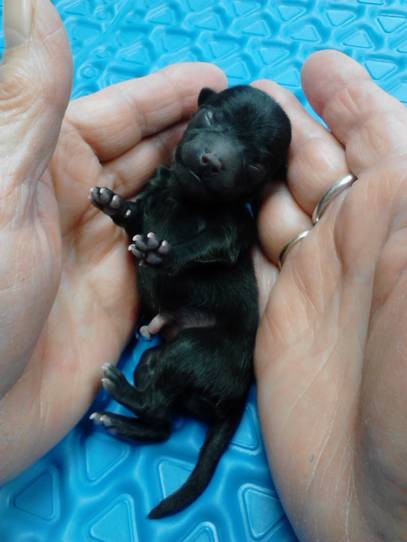
This is a picture of one of the tiniest puppies we have ever had. We named her Thumbelina, and we called her Thumb. We fought hard for her life for the first week, and during her second week there was a younger litter, and we switched her over from her own mom to this litter. Those puppies eventually grew bigger than her as well, but she grew up to be a beautiful, normal, healthy girl; and she has a family who loves her very much.
What you can see here, is a Schipperke tail the day of their birth. This one is long and thin, others are much thicker at the base, and they are often called "Christmas tree" tails. Most Schipperke puppies that have a full length tail like this eventually have a tail that flips over their back, and this happens anytime between 3 and 5 weeks of age.
Some Schipperkes are born with a bob tail OF VARIOUS LENGTH. This is a dominant trait called the TBox gene, and this means you only need one copy of the gene to have a bob tail. This is important - it also means it will come from only one parent, and that parent will ALSO be a bob tail. For years this was not watched because Schipperke tails were docked, but this is important, as puppies with 2 copies of the gene will likely never be born, or die shortly after birth.
Natural bob tails always vary in length! Some are half tails, some stubs, some nearly full. NO ONE HAS ALL NATURALLY TAILLESS SCHIPPERKES, no matter what country they live in!
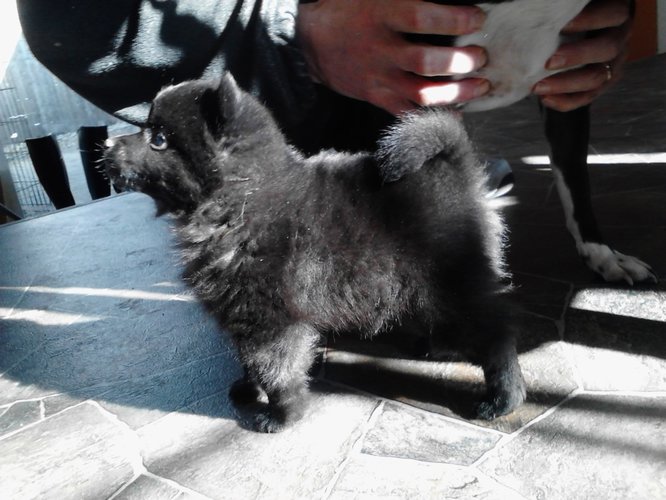
This is Thumb at 9 weeks old and it is one of my favorite pictures. It shows that a Schipperke can be as beautiful with a tail, as without! For many years, Schipperke tails were docked the world over, and they were docked so close so that they would appear tailless. This is actually a good way to tell if you have a "bad" breeder - if they have a stub tail and they are docked, they are docked VERY wrong. It is a very basic thing to the breed, and if such a breeder knows that litter, what else do they not know? Furthermore, many show breeders today dock TO SHOW, if they just want pets, why dock if you are going to do it wrong anyhow?

We are going to try to cover the laws in each country, each show arena. We are also going to try to collect pictures for this site to show what beautiful examples of this breed look like with their natural born tails. Since WE NO LONGER DOCK, this is an important issue for us!
|
There is now eleven fully tailed Schipperkes that are AKC champions, with more to follow!! This is a personal decision, not to dock, and it has been made by long standing, highly successful breeders. As in many other breeds, it has created friction in the breed as a whole, but someday I hope everyone will make a little room for ALL in the breed, whether tailed OR docked. In the meantime, look to see a few more Schipperkes with tails in the ring. We are a lucky breed in that we have been docking for over 100 years, except for those rare Schipperkes born without a tail, and yet the breed has a highly attractive tail despite that - one that fits in with the cobby silhouette and elegance of the breed. |

|
USA
AKC - a tail is a non-genetic deviation from the standard, not a disqualification.
UKC - natural tails and docked are both allowed, including bob tails
Finland - docking illegal, none can be shown, bob tails are desirable.
Belgium - docking illegal, bob tails acceptable
France - docking or natural acceptable
Russia - docking or natural acceptable
Australia - docking illegal, an imported docked dog allowed to be shown
England - docking illegal, an imported docked dog allowed to be shown
Germany - docking illegal, bob tails not preferred
New Zealand - docking not illegal, tails allowed
Canada - docking and natural tails both allowed
